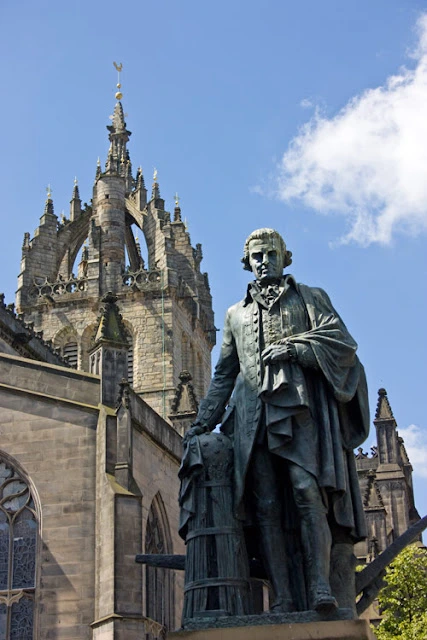
Adam Smith and Hong Kong
“If you want to see how the free market works, this <Hong Kong> is the place to come.”
–Milton Friedman (1912-2006)
While Adam Smith is clearly a well-known and well-respected name in Economics and the history of human thoughts, this doesn’t mean that his ideas have been well-understood; and still less that they have been adopted.
Indeed, we would say the world has understood at most 50% of his insights and thoughts in the Wealth of Nations; and many do not even know that he has another masterpiece called The Theory of Moral Sentiments. Still less appreciate that The Wealth of Nations really need to be seen and understood as the sequel of The Theory of Moral Sentiments and that some of the most profound insights of Adam Smith really come from seeing these two masterpieces as an integrated whole.
This is before we take into account that Adam Smith’s intellectual interest is very broad and have unfinished work related to history, jurisprudence, law, astronomy, aesthetics, philosophy etc. which he has asked his friends to burn shortly before his death.
As pointed out by Jerry Muller, what Adam Smith has been obsessed with is not merely about the ways to make men becoming wealthier but making them becoming better, and to him, the free market is an integral part of a broader political economy and social institutional structure which encompass far more than merely the free exchange and production of goods and services.
Seen in this light, allowing a private market for the exchange and production of goods and services represent merely accepting the most obvious parts of Adam Smith’s ideas and the effective operation and functioning of a fee market need to be augmented and supported by deeper foundations related to some fundamental beliefs about how the society should be organised; the proper role of the Government; the importance of property rights etc. And this is before we explore deeper into what a proper System of Natural Liberty is all about.
In retrospect, given that many societies already have their established institutions as well as political economy and social infrastructure when they came to know of the ideas of Adam Smith, many have just adopted the more easily adoptable parts of Adam Smith’s ideas and thoughts and then integrated them into their existing system.
Against this background, Hong Kong could represent an exception in that Hong Kong at one point did represent quite like a new society to be built, and it was small and clean enough to allow a few individuals at the top to exert significant influence on how it was to be built. In retrospect, it is arguable that John J. Copperwaite, the financial secretary of Hong Kong during 1961-1971, a fellow Scotsman of Adam Smith, has implemented a political economy experiment in Hong Kong along the lines of the ideas and thoughts of Adam Smith and many of such legacies have still lingered despite many subsequent developments which no longer fit into such experiment. While many things about Hong Kong have changed, on the whole, one might still say that, in relative terms, Hong Kong still comes among the closest, if not the closest, to a society built on the ideas and thoughts of Adam Smith.
Herein shall lie one key importance of Hong Kong as an illustration and experimental centre for the ideas and thoughts of Adam Smith. If some ideas and thoughts of Adam Smith are to be pursued – we think Adam Smith’s ideas and thoughts can be applied to many areas important to the Humanities in the modern world such as ESG, the Capital Market, the proper Firm/ Market relationship, Wealth distribution etc. – then Hong Kong should qualify for becoming one of the major centres for such experiment. In any case, we believe that Hong Kong’s past experiences do provide reference value as to what an Adam Smith city may be like and these would constitute important elements of what we call the Hong Kong Heritages, to be studied and treasured alongside with other Heritages produced by the Humanities in other societies, East and West, Past and Present.