Why would Smith, who was so rigorous in his own arguments and so serious in his academic approach, make such a bold prediction about the future of the United States more than 200 years ago?
Adam Smith was an author with extremely high standards for himself. It is said that a few days before his death, he asked a friend to burn all his unfinished works. This is a great pity and regret for the history of human thought, as Smith was a highly learned and original thinker. He was originally an ethics philosopher, but in the process of studying ethics and philosophy, he founded economics (which he defined as the “Science of Wealth”). In addition, he studied history, astronomy, literature, jurisprudence, taxation, and other subjects. Therefore, his unfinished works may contain many intellectual treasures.
We cannot know why Adam Smith treated his unfinished works so resolutely. One possible reason is that he only wanted to leave behind his satisfactory and completed works for posterity. His epitaph reads: “Adam Smith—author of *The Theory of Moral Sentiments* and *An Inquiry into the Nature and Causes of the Wealth of the Nation* (commonly known as *The Wealth of Nations*).”
Clearly, these two works occupied a very important place in his life, even defining his existence. Smith never married or had children, devoting his life to thought, even plunging into danger several times due to his absorbed contemplation. Could his burning of his unfinished works be related to his desire to leave nothing that might disrupt future generations’ understanding of his two masterpieces?
The injection of micro-injection even ignited the truth.
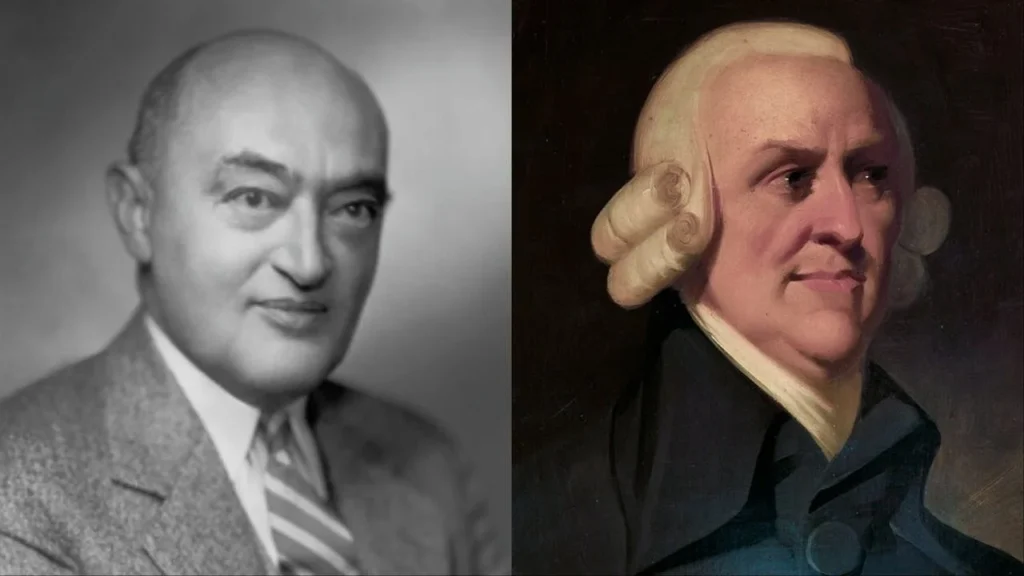
This is a very profound and insightful viewpoint. Warren Buffett once said that reading annual reports is like reading Playboy magazine for him. To be able to see through what most people consider mundane content to the point of resembling a magazine magazine—I believe very few people besides Buffett can reach such a level of understanding and mastery. Some say that Schumpeter was, after Smith, the person who understood the essence of market mechanisms most deeply. His concept of “creative destruction” under market mechanisms is a very original and inspiring idea. Schumpeter clearly greatly admired Smith, but I believe it takes a very high level of cultivation to appreciate the depth of his understanding.
What are the reasons behind such bold arguments?
This raises the question of why Smith, a scholar so rigorous in his own arguments and so meticulous in his scholarship, would make such a bold prediction about the future of the United States more than 200 years ago. Although Smith was generally very cautious in his writing, he made at least two rather bold arguments, one concerning the United States and the other concerning the nation’s capacity to eradicate poverty. The latter, as I have previously pointed out, is stated in the following text:
Little else is requisite to carry a state to the highest degree of opulence from the lowest barbarism, but peace, easy taxes, and a tolerable administration of justice; all the rest being brought about by the natural course of things.
In my opinion, Smith’s two bold arguments are identical, and the logic and basis behind them are related to the famous quote from Einstein cited at the beginning of this article. They can also provide many insights into the future of Hong Kong, which I will discuss next time.