The Bretton Woods Conference laid the foundation for the United States' global economic and financial position.
The renowned economist Keynes was disappointed with the outcome of the Bretton Woods Conference. However, overall, he successfully persuaded the United States to become a pillar in driving the reconstruction and recovery of the global economic order. Considering the various limitations, what he achieved was no small feat.
They are employed in contriving a new form of government for an extensive empire, which, they flatter themselves, is to become, and which indeed seems very likely to become, one of the greatest and most formidable that ever was in the world……
── 亞當·史密斯(Adam Smith)
In the previous article, I mentioned the significant global responsibility the United States bore during World War II, and its participation was believed to be a key factor in the Allied victory. It’s worth noting that the US’s importance to the world after World War II may have been even greater than during the war, given that the war left the entire globe devastated, and the world’s wealth flowed to the United States. Records show that at the end of World War II, over 80% of the world’s gold reserves were held in the United States. Under these circumstances, the global economic recovery after World War II hinged on US support .
Two options for the Bretton Woods Conference
Economist Keynes and the top British government officials at the time were well aware of this. At the 1944 Bretton Woods Conference, which determined the postwar global financial order, Britain strongly advocated that the United States lead the reconstruction and recovery of the global economic order . It is worth noting that the conference actually had two proposals: the “British Plan” proposed by Keynes and the “American Plan” proposed by the US representative, Harry Dexter White. Keynes’ plan focused more on the long-term operation of the entire system , while the American plan emphasized US control over the postwar global financial order.
From a theoretical perspective, I believe Keynes’s plan is more sophisticated because it emphasizes the overall sustainable development and balance of the global economy and proposes the implementation of a world currency called Bancor. Under Keynes’s plan , countries with export surpluses or deficits would naturally generate economic forces to gradually adjust their situations. In contrast, Weber ‘s plan is more focused on the interests of the United States and its economic dominance in the post-war world.
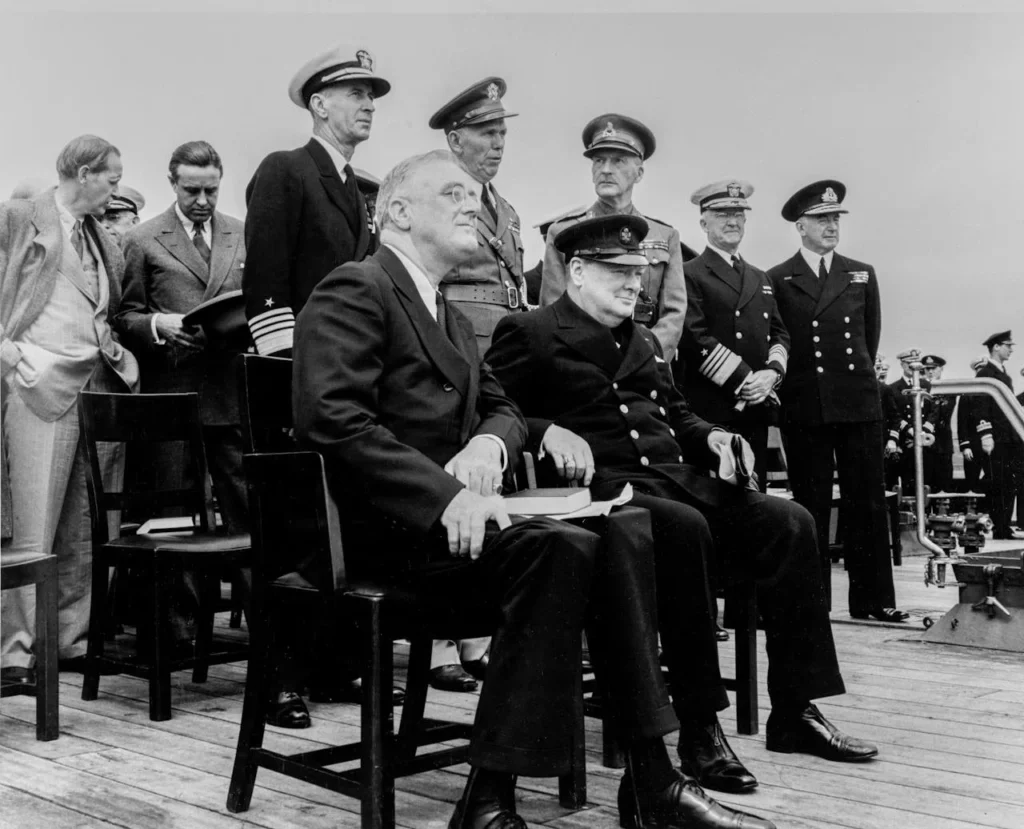
From August 9 to 12, 1941, then-US President Franklin D. Roosevelt and British Prime Minister Winston Churchill reached the Atlantic Charter. (Wikimedia Commons)
Deconstructing the Bretton Woods Conference
Records indicate that a heated debate ensued at the meeting, with Keynes strongly advocating his proposal and demonstrating considerable debating and negotiation skills, as well as an understanding of the practical limitations . Nevertheless, the final outcome of the meeting was that, in terms of specific arrangements, the main approach adopted Weber ‘s plan. This is understandable, given that Britain at the time had virtually no bargaining power with the United States. The fact that the United States essentially accepted Keynes ‘s framework and yielded to his suggestions in key areas was perhaps the greatest achievement it could make given the practical constraints.
As a result , the conference did not result in a world currency. Instead, countries agreed on a fixed exchange rate with the US dollar, with the US pledging to exchange 35 dollars for one ounce of gold . Furthermore, the International Clearing Union, proposed by Keynes, was not established. Instead, the International Monetary Fund (IMF) was formed, but with far fewer resources than Keynes’s initiative. The IMF also tended to target countries with economic problems and fiscal deficits, rather than considering the overall system.
According to reports, Keynes expressed disappointment with the conference’s outcome. This is understandable, given that his proposed plan was quite innovative and ambitious , attempting to both align with objective realities and guide the world towards a path of sustainable and balanced development. However, despite the conference’s shortcomings in some details, he generally succeeded in securing the United States as a pillar in driving the reconstruction and recovery of the global economic order . Considering the various limitations, what he achieved was no small feat.
Later, the global economy and trade recovered much faster after World War II than many people imagined, and the contributions of the Bretton Woods Conference and the United States to this cannot be denied.
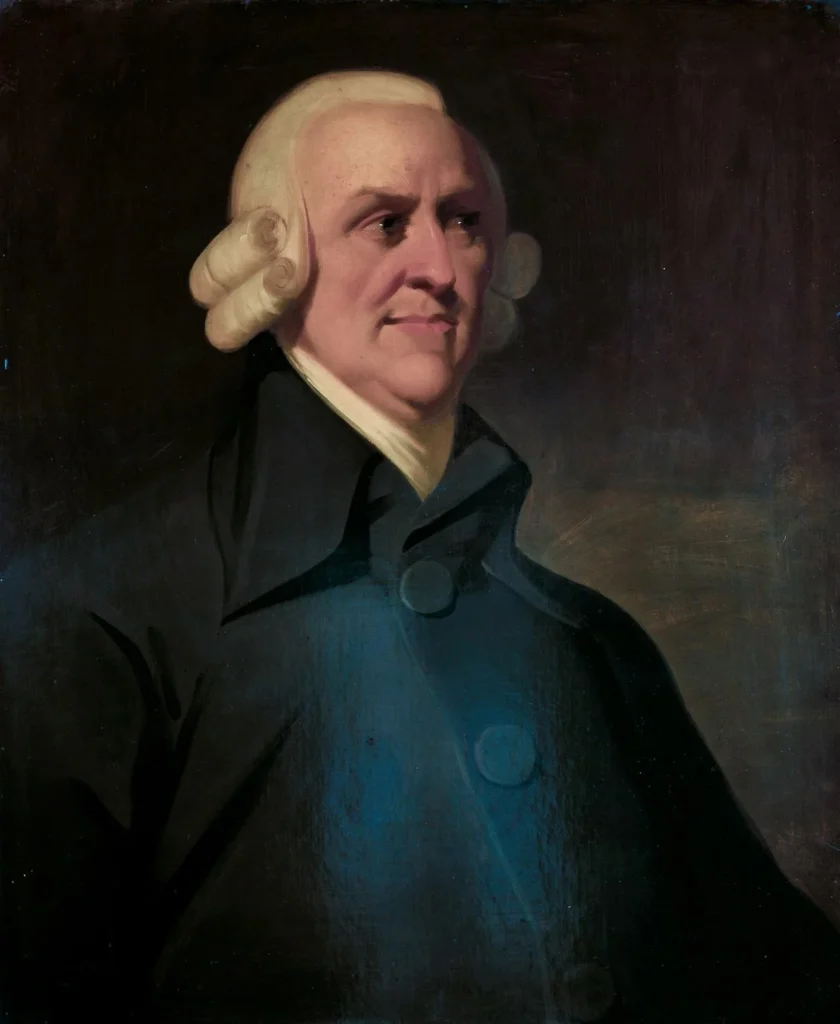
Adam Smith predicted long ago that the United States would become the most powerful country in the world. (Wikimedia Commons)
Adam Smith's Bold Predictions
This raises the question: why does the United States we see today seem like a completely different country from the one of decades ago? Looking at Trump’s treatment of Zelensky, and the recent treatment Zelensky has received at the White House , what appears to be blatant power politics—a great power bullying a smaller one—some even say it resembles gangster tactics. How much of this reflects Trump’s personal style, and how much reflects the true nature of America?
What kind of country is the United States, really? The introduction to this article reveals that even before the US achieved independence, Adam Smith predicted it would likely become the most powerful nation in the world. Those familiar with his work know that Smith was a very cautious person when making his arguments . What led him to make such a bold prediction? What implications does this have for the nature of the United States and the source of its vitality? I will discuss this further later.