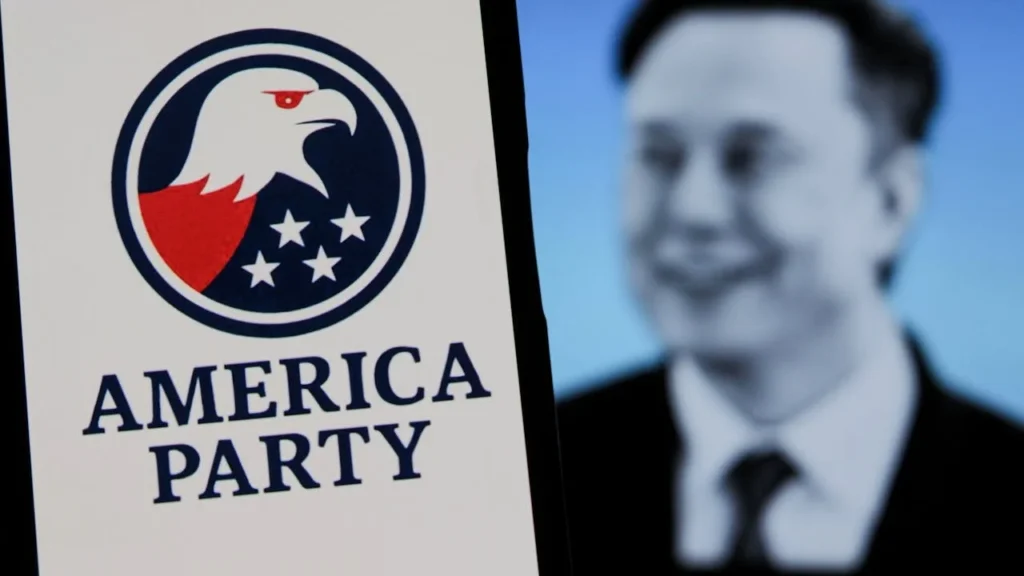

The ability to achieve seemingly impossible visions is the lifeblood of society and the economy.

No matter how low the chances of Musk’s American Party succeeding are, American society allows him to try this. In other parts of the world, would this idea be possible to be put into practice?

Author: GUDORDI |  2025-08-19

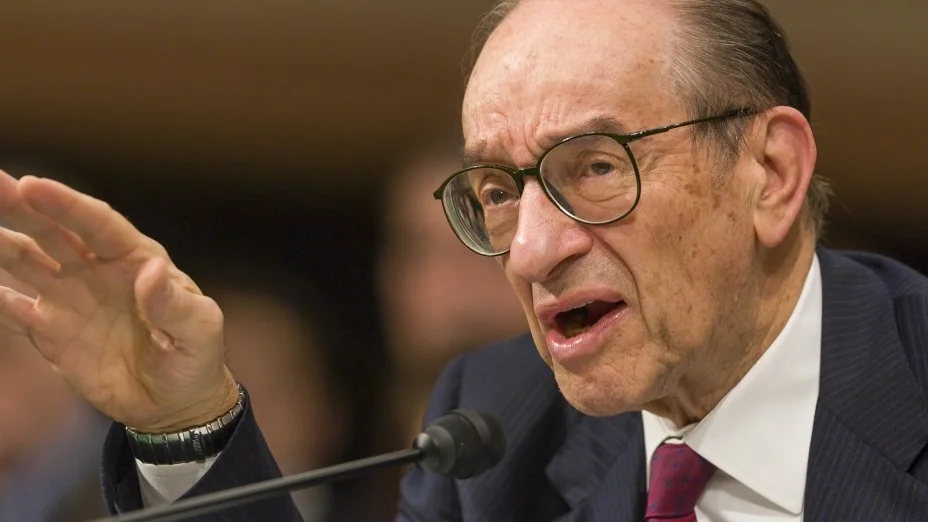
馬斯克在美國地位不俗,打破逢商必奸的負面印象。(Shutterstock)
Musk enjoys a high status in the United States, breaking the negative stereotype that all businessmen are unscrupulous. (Shutterstock)
Facebook
Twitter
LinkedIn
Pinterest
WhatsApp
Email

The land we have today is not inherited from our ancestors , but borrowed from our children…

We do not inherit the earth from our ancestors, we borrow it from our children…

—Chief Seattle/Oscar Wilde/Anonymous

In the previous article, I mentioned that the modern economy is driven by expectations of the future , and a series of questions arise from this, such as: What are the main determining factors of expectations for the future ? Is it necessary for the government to put forward visions and guidelines? How effective can the vision of a single person be? These are all difficult questions to answer.

The merchant as defined by property rights economics

Musk’s case is particularly thought-provoking when considering related issues. In many cultures, including China, businessmen generally hold a low social status, and the stereotype of “all merchants are cunning” is a common label attached to them, a concept that may have existed and persisted for thousands of years. However, Musk’s emergence seems to have shattered many people’s preconceived notions.

On a deeper level, so-called businessmen are simply people who choose not to be employees, preferring to bear the uncertainty and risk themselves. From this perspective, taxi drivers and street vendors are businessmen, or at least have elements of businessmen, and are essentially no different from company owners with many employees. Property rights economics offers a similar understanding: so-called businessmen are those who would rather directly face and bear the various uncertainties of the market than become followers of the visible hand or the institutional arrangement of a company. 

Many people do not need to face the vast ocean of the market.

Importantly, if we continue to look at this issue from the perspective of property rights economics, we will only accept two economic institutional organizations: one is the company, which symbolizes the visible hand, and the other is the market, which symbolizes the invisible hand; and in between the two are countless contractual arrangements that are a mixture of corporate and market characteristics to varying degrees.

If we take this perspective further, we might use a vast ocean to represent the entire market, as well as the economy and society as a whole. Within the market, there are many different parts, and not every part directly faces the potential storms. Many parts of society, such as the public and semi-public sectors, do not directly face market and economic realities; their positions are similar to the back-office and mid-level departments within a company. Even within private companies, perhaps only the front-line departments directly face the market, while other departments may simply follow the instructions of the “visible hand” of government. This does not mean that market pressures do not exist for them; it simply means that there are forces and departments acting as buffers between them and the market.

商人只是那些選擇了直接面對市場的人,在因緣際會之下,可能影響到巿場的發展軌跡,這跟他們是否奸詐沒有必然的關係。(Shutterstock)

Merchants are simply those who choose to directly confront the market. Through a series of coincidences, they may influence the market’s trajectory, which has no necessary connection to whether they are cunning or not. (Shutterstock)

Merchants are not necessarily cunning.

However, some people in the world, for various reasons, refuse to be crew members who follow orders, preferring instead to face the sea and steer their own ships. The size of the ship can vary greatly, some as small as a sampan, others as large as an aircraft carrier, but the underlying concept is the same: to dance with the sea, which symbolizes the invisible hand. Most of the time, they can only try to follow the market’s rhythm, but under favorable circumstances and circumstances, it’s not entirely impossible to influence the market’s trajectory to some extent.

Therefore, it’s not necessarily true that businessmen choose to directly face the market, nor is it necessarily related to whether they are cunning or not. It’s worth noting that the opportunity to deceive others may only come once or twice at most. Therefore, if a company intends to operate sustainably and pass on its legacy, there is a strong incentive to build trust with employees, customers, suppliers, and all parties involved. And to build trust, honesty and keeping promises are far more effective.

In a sound market system, the rights of all participants are theoretically protected, and any change in anyone’s business behavior must be based on voluntary participation. Therefore, a free market system provides a significant incentive for all parties to seek common ground while respecting differences and to exercise mutual understanding and accommodation. The saying “all merchants are cunning” is an oversimplification.

Musk and the American system

In Musk’s case, Buffett’s perspective is insightful: he believes Musk highlights the uniqueness of the American system. He has also said something similar: “This is America… You just need to dream it…”

The key question is, regardless of the slim chances of Musk’s American Party succeeding, American society allows him to attempt something like this. Would this idea be feasible in other parts of the world? More importantly, as pointed out in the introduction, the present society and the future are inextricably linked. Could allowing everyone in society to boldly experiment be the key to a society’s and economy’s long-term vitality? What implications does this have for Hong Kong’s future?
 

Leave a Comment

Your email address will not be published. Required fields are marked *

Scroll to Top