要應付解決迫切的問題往往是發明創新之母。 Necessity is the mother of invention.
──柏拉圖(Plato)
In my previous column, I mentioned that economic transformation is a daunting and complex challenge—one that many economies throughout history have struggled to manage effectively. From this perspective, Hong Kong’s past achievements are quite remarkable; its multiple successful transitions were largely organized and driven by the participants within the economy themselves.
Undoubtedly, policies like the Individual Visit Scheme (IVS) have been vital. However, a closer look reveals that the primary engine behind these policies remains the market. The government did not appear to invest massive effort into top-down planning or execution, which may actually have been a blessing. No matter how much heart a government puts into planning, the results rarely match the efficiency of adapting to market forces and reality.
The Experience of the Domestic Economic Miracle
The author is reminded of the economic miracle sparked by China’s Reform and Opening-up in 1978. Some attribute this phenomenon to the powerful combination of market forces and government action, creating a virtuous cycle. Undoubtedly, the government played a monumental role, particularly in its steadfast commitment to the policy, which fundamentally transformed the underlying structure of the economy.
If we look closer, however, we may find that—at least in the initial stages—the entire policy did not resemble a detailed, pre-ordained plan, let alone a master blueprint. Much of the development was simply the natural evolution of market forces. Concepts once held as sacred in China, such as “crossing the river by feeling for stones” and “it doesn’t matter if a cat is black or white, as long as it catches mice,” highlight this remarkably pragmatic philosophy.
Later, waves of entrepreneurs took risks through trial and error, while workers from all directions made their own choices and efforts. Local governments at the provincial, county, and township levels competed with one another, guiding development according to prevailing trends and making trade-offs based on common sense and reality. Through the interaction of these diverse forces, domestic industry began to flourish like bamboo shoots after rain. Coupled with the massive market access brought by China’s accession to the WTO, a “World’s Factory” and a globally integrated supply chain were established.
Considering the vast human labor, transportation, infrastructure, and the constant coordination required, it is hard to believe that even the most powerful planning department or AI system could have pre-designed such a blueprint. Yet, the market managed to manifest this reality with miraculous precision.
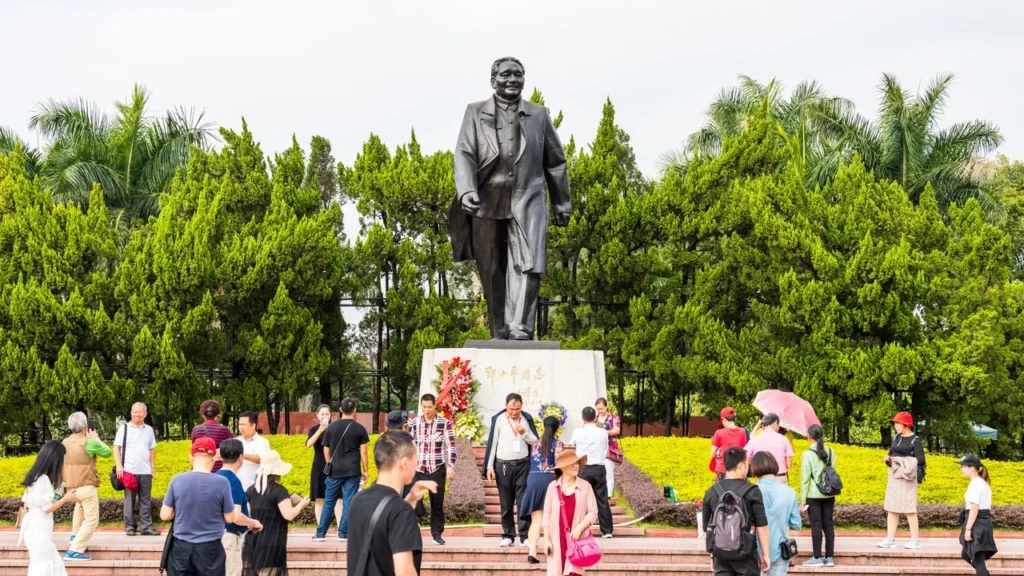
改革開放政策初時只是順應巿場力量自然演化。(Shutterstock)
The Underlying Logic and Transformation Principles of Market Forces
Once we recognize the power demonstrated by the free market during China’s Reform and Opening-up, Hong Kong’s past economic successes become much easier to comprehend. This leads to a more fundamental question: What is the underlying logic of market forces? While this is an incredibly complex issue, I believe one of the most vital sources of the market’s “magic” lies in the concept mentioned in the opening quote—specifically, Hayek’s theory on how society utilizes knowledge. From this perspective, the spirit of the market lies in the courage to face reality and the proactive drive to solve problems.
As for the principles by which a market handles economic transformation, it begins with an individual or an enterprise willing to use the information they possess to take that first step. Simply put, if results meet expectations, they will likely expand their investment; if not, they will pivot or halt. Regardless of the outcome, they have signaled their information to the world, demonstrating that they believed the attempt was worthwhile.
Observers may then choose to ignore the move, wait and see, or draw from that experience to inform their own attempts. The latter creates a continuous and growing momentum for experimentation. Initially, everyone focuses on solving immediate, local problems. However, as more of these small issues are resolved, a clearer vision and path gradually begin to emerge. Once the collective drive to solve these problems becomes strong enough to lead the economy toward a new direction, the process of transformation has truly begun.
The True Miracle of Compounding
Warren Buffett frequently emphasizes that the underlying logic behind Berkshire Hathaway’s staggering investment performance is the power of compounding. Even Albert Einstein is said to have hailed it as the “Eighth Wonder of the World.” However, they were likely referring to the incredible effects of accumulation over time. In the context of market operations, the benefits of compounding should also include the accumulation of knowledge held by market participants and the synergistic effects of their continuous interaction.
Perhaps we can say that Adam Smith’s most significant insight was that human relationships in society are not necessarily a zero-sum game; instead, we can be unconsciously guided toward co-creating a legacy. In the next installment, I will further demonstrate this using Hong Kong’s actual experience as evidence.