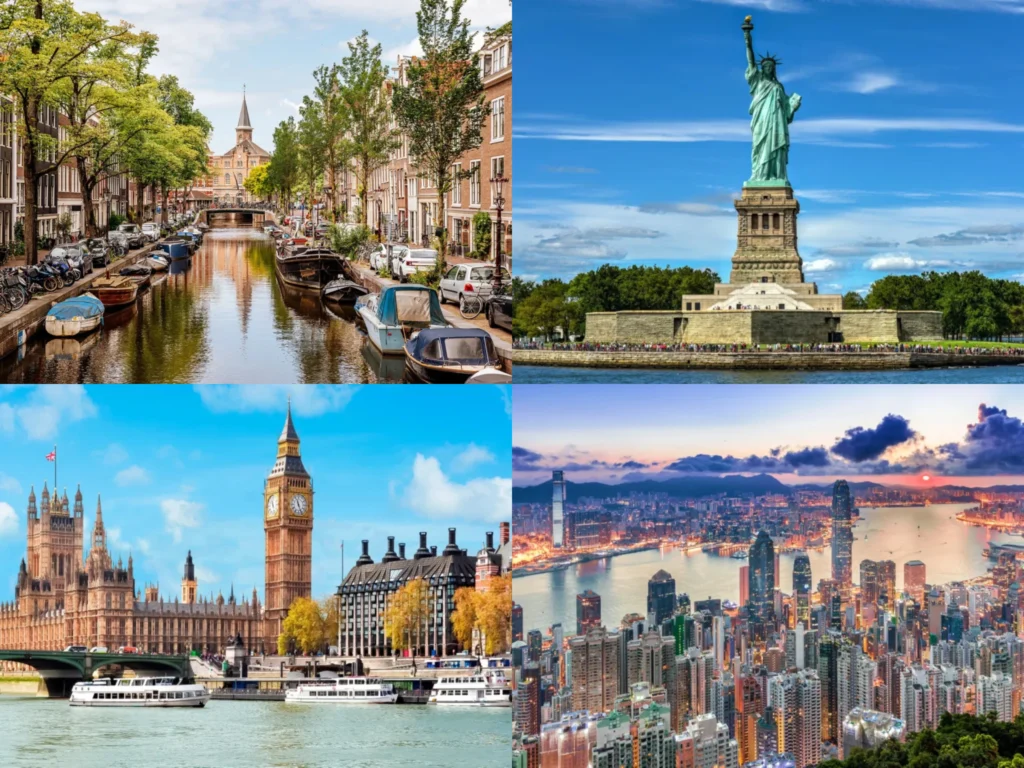
Amsterdam, London, New York & Hong Kong
“Finance capitalism was no newborn child of the 1900s; I would argue that in the past — in say <17th century> Amsterdam, finance capitalism was already in a position to take over and dominate…”
Fernand Braudel
“If, at least until the end of the 17th century, all roads in this global North Atlantic led to Amsterdam, it may be useful to begin with the specificities of the Dutch Road to capitalism…400 years ago a village by the name of Amsterdam .. invented capitalism as we know it and became the richest city on the European continent..”
Jason W. Moore
In retrospect, the modern global financial architecture began taking shape in Amsterdam since the 16th to 17th century. In the early 1600s, the city pioneered a complete system of capital markets featuring public debt, perpetual equities, active secondary trading platforms and a central system for currency exchange, transfer and settlement – innovations that form the backbone of the modern day global financial architecture.
In 1602, The Dutch East India Company issued the first publicly traded shares . Unlike temporary partnerships before, these shares were perpetual, and a notary record on 31 August 1602 formally recognized their transferability, creating the world’s first liquid secondary market.
In 1609, two more financial institutions emerged in Amsterdam. One is the Amsterdam Exchange Bank which provided solutions to currency chaos and introduced stable “bank money”. Another is the Amsterdam Stock Exchange which formalized trading of stocks and created the world’s first stock market and first set of regulations on the stock market.
However, across the Dover Strait, London was rapidly re-building after suffering from the Great Fire in September 1666 and the Dutch’s defeat in the in fourth Anglo-Dutch war in 1784 marked the UK’s replacement of Holland as the world’s economic superpower as well as London’s replacement of Amsterdam as the world’s financial centre which was further reinforced by the Exchange Bank in Amsterdam was dissolved in 1820.
London’s financial strengthen, however, was significantly dampened by the two world wars which has also resulted in New York replacing London as the global financial centre although the emergence of Petrodollar, the big bang and the development of the offshore international financial centres has enabled London to gather some new strengths in global finance from the 1990s onwards. However, the post-war global economic and financial order built on the Bretton Wood Agreement of 1944 was essentially a US-centric one and New York’s No. 1 position in global finance is unchallenged since the end of World War II.
It is against this background that Hong Kong gradually carved its position in the international financial architecture. Compared with London and New York, Hong Kong’s history as an international financial centre is much shorter. Indeed, before the 1990s, Hong Kong was merely one of the financial centres in Asia ex-Japan. That said, starting from the 1993, Hong Kong gradually started to be the financial market to undertake the experiment of using the global capital market to revitalize China’s corporate sector. More importantly, after the dual listing of China Mobile in both US and Hong Kong in October 1997, it has become increasingly clear that Hong Kong is the most suitable market for becoming the principal capital formation centre for Chinese corporations and this then heralded the listing of virtually all of the largest enterprises from China in the Hong Kong stock market from the 2000s onwards and has driven a dramatic surge in the stock market capitalization of Hong Kong..
More importantly, the Stock Connect introduced in 2015 has further secured Hong Kong the position to be the principal offshore international financial centre of China. In retrospect, the momentum in the development of Hong Kong’s capital markets has slowed down somewhat from the 2020s onwards as a result of growing cautions in the US and the global investing world about embracing Chinese corporations and further integration of China into the global economic and financial architecture.
Such was the state of the market as of now, with questions abound as to whether Hong Kong’s development as an international financial centre has more or less run its course or the city can eventually find the ways to keep developing along the lines of London and New York to be the principal international financial centre in the Asia time zone.
Lord Palmerson has made a famous remark in 1841 that Hong Kong at that time was only “a barren island with hardly a house upon it.” It was of absolutely no significance to the world at that time and it is also beyond the wildest imagination of probably anyone at that time this little island could ever command any real significance in world affairs in the future.
Yet, history is often full of surprises. Hong Kong is still not yet a city that commands real importance to the world at large. That said, it looks fair to say that it has gone a long way already from where it starts in terms of relevance and importance to the world economy and the story of the Human civilization. And we do take the view that the city has considerable credentials and potential to still go much further along such path.
And one key catalyst to this could well be Adam Smith.
We would argue that the architecture of the modern world comes considerably from the ideas and thoughts of Adam Smith. And among all cities in the world, Hong Kong may still rank among the top in terms of the relative penetration of Adam Smith’s ideas & thoughts into their social and economic fabric.
More importantly, we take the view that the story of the Human Civilization would soon enter into a new phase in the years to come. How that would unfold would depend on many evolving parameters but we would argue that greater appreciation and understanding of Adam Smith’s ideas and thoughts, in particular his unspoken and unfulfilled vision on human societies, could well be among the healthiest and most balanced forces to shape the coming courses of the story of Human Civilization.
And to the extent that Hong Kong is linked to both the East and the West in some unique and special ways, the relevance and importance of this city in the story of the Humanities could well reach another level in the years to come The attached ppt summarises some of our current thoughts on this subject matter.